



Pressure Points for Migraine Relief
- What are pressure points?
- Migraine trigger points vs. acupressure points: What’s the difference?
- Do pressure points work for treating a migraine attack?
- Pressure points for migraine on ear
- Hand pressure points for migraine
- Foot pressure points for migraine
- Tips to use pressure points for migraine relief
Ever find yourself with a migraine headache, seeking quick relief? You’re not alone. Migraine can be downright exhausting, and you’ll search for anything to ease the pain. Fortunately, some relief may come in the form of pressure points.
Imagine having the power to ease some of your migraine symptoms at your fingertips — literally! We’ll discuss all you need to know about migraine relief and acupressure. We’ll highlight key pressure points and provide simple techniques you can try at home.
Try CEFALY to Prevent & Relieve Migraine Pain
What are pressure points?
Think of pressure points as tiny hubs of energy located throughout your body. Some believe that these interconnected points can influence the body’s energy flow. You might have heard of this before — qi (pronounced “chee”). This is where acupressure comes in. This traditional Chinese medicine technique uses the body’s pressure points to promote healing.
You might wonder if acupressure is the same as acupuncture — not quite. Both may involve stimulating specific points on the body, but it’s the method that differs. Acupuncture uses needles, while acupressure uses hands.
How does all this relate to migraine relief? Some believe that stimulating specific pressure points can help reduce pain. Stimulating these pressure points can relieve tension and improve blood flow. It may even trigger the body’s natural pain-relieving mechanisms. Targeting specific pressure points in your body may help ease a throbbing migraine headache.
Migraine trigger points vs. pressure points: What’s the difference?
Migraine trigger points are different from pressure points. Trigger points refer to hyperirritable spots within muscle tissue that can cause referred pain and contribute to migraine onset. These often form in areas of chronic tension such as the neck, shoulders, and upper back. When these muscles tighten or develop knots, they can irritate surrounding nerves and blood vessels, potentially triggering migraine attacks.
How to massage or treat migraine trigger points safely
Unlike pressure points, which target systemic energy flow, trigger point therapy focuses on localized muscle tension and its role in pain pathways.
Migraine trigger points are treated through several approaches, each aiming to release muscle tension and reduce referred pain. Manual therapy is one of the most common methods, involving techniques like ischemic compression, deep tissue massage, and stretching to deactivate the hyperirritable spots in muscles. These techniques improve blood flow, reduce muscle spasm, and restore normal muscle function. Some studies show that regular sessions of manual trigger point therapy can decrease migraine frequency and intensity, and even improve neck mobility, which is often compromised in migraine patients. Self-care methods such as applying sustained pressure with fingers or massage tools, or using vibration massage, can also help maintain results between professional treatments.
Another widely used option is trigger point injections (TPIs), which involve injecting a local anesthetic—sometimes combined with a corticosteroid—directly into the affected muscle. This blocks pain signals and reduces inflammation, providing rapid relief for severe or persistent migraine-related pain. TPIs are typically performed in a clinical setting and may be combined with peripheral nerve blocks for enhanced effect. They are considered safe and effective for patients who have clearly identifiable trigger points and have not responded well to other treatments. While TPIs offer immediate relief, they are often integrated into a broader migraine management plan that includes physical therapy, lifestyle adjustments, and preventive medications for long-term control.
Do pressure points work for treating a migraine attack?
You might have heard how hitting the right migraine trigger points can work wonders. Many people who experience migraine swear by the power of pressure point therapy. Some claim it’s their go-to for relief when those head-splitting pains strike.
But what does the science say? Studies have found that acupressure can be helpful for migraine relief. Stimulating specific pressure points may reduce migraine attacks’ frequency, severity and duration. Additionally, pressure points have shown efficacy in managing associated symptoms like nausea.
That all said, there aren’t enough recent studies to verify these claims. Individual variation plays a large role. Just like how we all have different pain thresholds, our bodies may respond differently to pressure point therapy. What works like a charm for one person might not have the same magical effect for another.
But there is a silver lining. Even though we lack evidence, many continue to use trigger points to relieve migraine. And when you’re dealing with the pain of a migraine attack, it’s all about finding what works best for you.
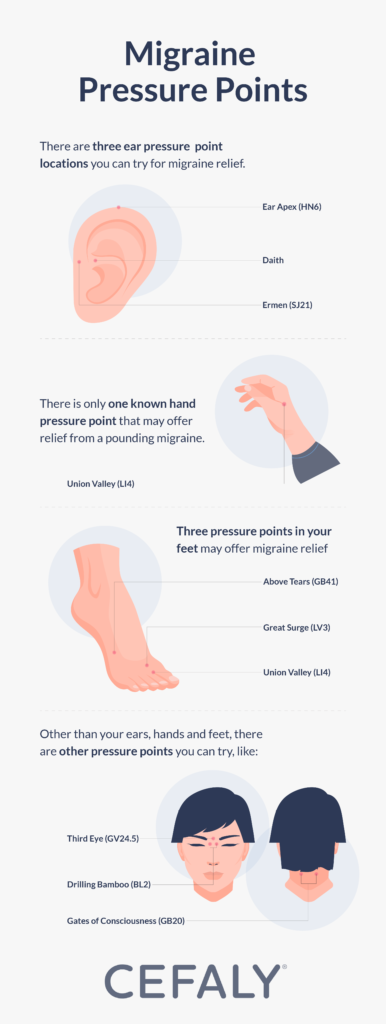
Migraine pressure point locations
Let’s uncover the key migraine pressure points.
Pressure points for migraine on ear
There are a few ear pressure point locations you can try out for migraine relief:
- Ermen (SJ21): This point is also known as the Ear Gate. It’s between the top of where your earlobe begins and your temple. Gently apply pressure and massage this area. You may find relief from facial or jaw pain associated with a migraine attack.
- Ear Apex (HN6): You can find this spot at the very top center of your ear. Stimulate your ear apex pressure point to help ease migraine intensity. Applying pressure to this area may also help ease head pain and discomfort.
- Daith: The Daith is near your ear’s opening. It’s the smallest fold of cartilage, toward the front of the ear. Some people get daith piercings as they believe it can help with migraine relief.
Hand pressure points for migraine
There is only one known hand pressure point that may offer relief from a pounding migraine:
- Union Valley (LI4): Hegu, or Union Valley, is where your thumb and index finger meet. Applying firm pressure to your LI4 may help reduce migraine headache intensity and duration. This makes it a go-to spot for migraine sufferers seeking relief.
Foot pressure points for migraine
Let’s explore a few pressure points in your feet for migraine relief:
- Moving Point (LV2): The Moving Point, or Xingjian, is between your big and second toes. Some say this point is particularly effective for reducing migraine frequency.
- Great Surge (LV3): The Great Surge, or Tai Chong, is in a similar location to your LV2. It’s about 1 to 2 inches from the base of your big toe. Stimulating this point may help with migraine relief and associated symptoms. Some say that LV3 may help relieve anxiety and lower blood pressure.
- Above Tears (GB41): Your Above Tears, or Zulinqi, is between and back of your fourth and fifth toes. Stimulating the GB41 is believed to reduce migraine attack frequency.
Other migraine pressure point locations
Other than your ears, hands and feet, there are other pressure points you can try, like:
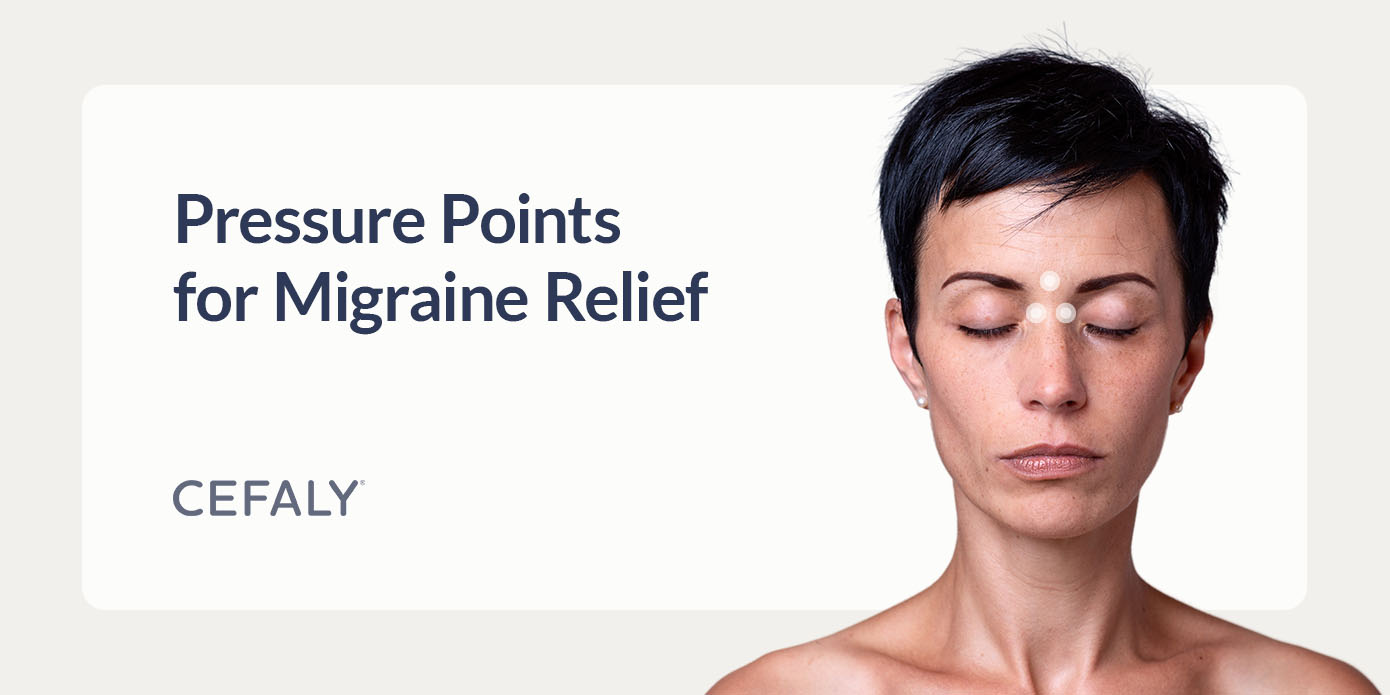
- Third Eye (GV24.5): The Third Eye, or Yin Tang, can also be a vital migraine relief pressure point. Your Third Eye is right between your eyebrows. Applying a little pressure here may reduce migraine pressure and discomfort. Also, some say it can ease stress and tension and promote relaxation.
- Drilling Bamboo (BL2): The Drilling Bamboo, or Zanzhu, points are right where your eyebrows meet. They’re on either side of your Third Eye. Stimulating your BL2 may ease migraine pain.
- Gates of Consciousness (GB20): Imagine two points where your neck muscles and skull meet. The Gates of Consciousness, or Feng Chi, are other pressure points for migraine relief. When targeting this area, you may find relief from migraine headache and other symptoms.




Tips to use pressure points for migraine relief
Acupressure may be very new to you and can be a bit confusing. We get it! Here are a few simple tips and tricks you can follow:
Proper techniques for applying pressure
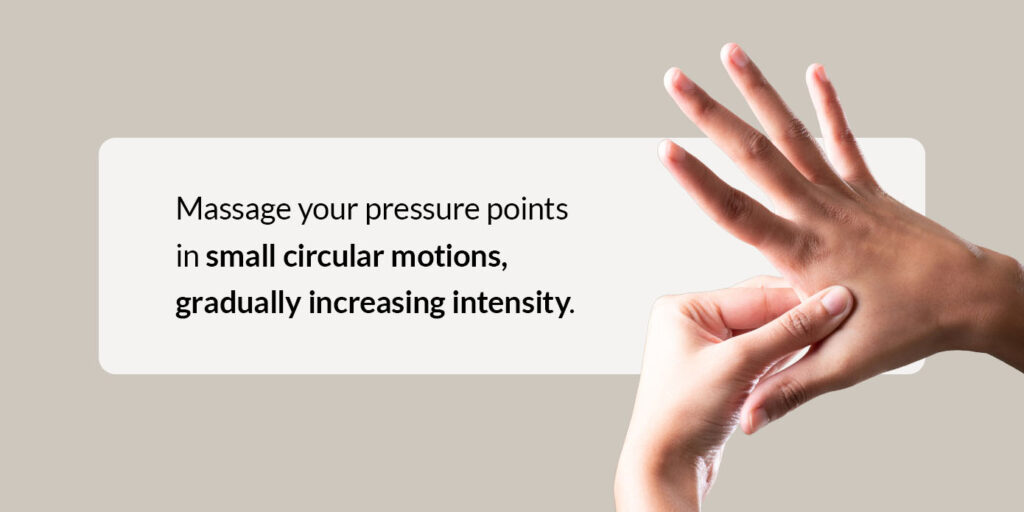
Firm but gentle pressure is essential when targeting pressure points. Avoid applying too much force, which can lead to discomfort or injury. Always use your fingertips or thumbs to apply pressure. Massage your pressure points in small circular motions, gradually increasing intensity. Experiment with different levels of pressure to find what works best for you.
Duration and frequency
There’s no set rule for how long or how often to practice pressure point therapy. That said, consistency is key. Aim for five to 10-minute sessions several times a day or whenever you feel a migraine attack coming on. Remember, listen to your body. Feel free to adjust these sessions’ frequency and duration based on your needs.
Complementary practices
Pair complementary practices — like breathing exercises or meditation — with acupressure. Deep breathing techniques can help you relax, while meditation can ease tension. Incorporate these practices into your acupressure sessions for a holistic approach.
Incorporating other therapies
There are other holistic therapies to try out, like aromatherapy or heat/cold therapy. This combined approach may amplify the benefits. For instance, using a warm compress on the forehead or neck can ease tension and promote relaxation. A cold compress can help numb pain and reduce inflammation.
Try CEFALY for effective migraine relief
While acupressure’s effectiveness varies from person to person, it can be a viable option for migraine relief. Coupled with proper techniques and complementary practices, acupressure is part of a holistic approach to migraine relief.
Another essential part of an integrative migraine treatment plan: the CEFALY migraine treatment and Prevention device. Our device offers drug-free relief by targeting the trigeminal nerve — the primary pathway for migraine pain.
Explore our clinical studies and product reviews.






Latest Posts


“CEFALY Gave Me My Life Back”: Camille’s Search for a Drug-Free Migraine Treatment
Discouraged by her experience with medications, Camille began building a toolkit of non-pharmacologic migraine treatments. Find out what…

What Patients Need to Know About Episodic Migraine vs. Chronic Migraine
While official definitions classify episodic migraine as fewer than 15 headache days per month and chronic migraine as…